Showing posts with label ananya ghosh. Show all posts

Sunday, April 1, 2012

The Doll House


It was a Sunday and the Hooghly River was blushing from the subtle flirting of the morning sun. I was taking a lazy stroll along the Strand Bank Road watching the city slowly wake up. Lined with old dilapidated buildings, time seems to have come to a standstill on this narrow stretch between Sovabazar and Kumortuli. I have walked this walk many times but never noticed what I did on this winter morning. Half hidden behind trees and other ruins, like a mirage, was a lone man standing with one arm raised amid a bunch of fragile women on an ornate terrace — all frozen in time.
The statues had something sad and eerie about them and it seemed they were beckoning me to their world. But there was no door!
I asked a man brushing his teeth on the street: “Dada oi baritaye jabo. Rasta ta...?”
“O putul bari jaben! Eito edikey,” he grinned flashing his lather-laden teeth.
Putul Bari! Doll House! Interesting I thought!
When I reached the half-ruined building I wasn’t much impressed. It looked like the other multitudinous dilapidated structures. I was not too sure if I should go in. I knocked on the door:
“Is there anybody there?’ he said.
But no one descended to the Traveller;
No head from the leaf-fringed sill
Leaned over and looked into his grey eyes...,”
But, I was luckier than De La Mare’s traveller and the door was not locked! As I pushed the door it screeched and a strip of light made its way to the dark cobweb-laden wooden staircase. As if in a trance, I started climbing the stairs and it was then I realised how dilapidated it was. At certain points the wood was crumbling and with each step it screeched, piercing the dead silence of the house. But the sight
that greeted me when I reached the first floor almost took my breath away — a courtyard hemmed with elegant Corinthian arches oozing baroque grandeur. And the mellow chiaroscuro was lending it an ethereal charm.
As I stood mesmerised at the middle of the courtyard, I started feeling increasingly uncomfortable —as if there were people staring at me from all corners. I looked around. There was no one but a strange bearded man peering from each of the arch. There was something eerie about the face. It seemed he was keeping an eye on trespassers like me. I tried to shrug away the feeling and concentrated on the intricately designed figurines perched on the columns. Although the elaborate detailing in stucco and plaster has fallen prey to the ravages of time, I could discern almost all the popular members of the Hindu pantheon from amid thick layers of moss.
As I explored the ‘shadowiness of the still house’ I realised that the house, tagged as a heritage structure by the Kolkata Municipal Corporation, is not inhabited by ‘Phantom listeners’ but with real people! Makhan Lal Natta, an old man who owns a more than the 140-year-old Natta Company, acquired the property in 1978 and now the third floor of this grand mansion doubles as his office. The rest of the rooms are occupied by ‘tenants’.
It is hard to believe that this magnificent building which served as a shooting location for Roland Joffé’s City of Joy and which Desmond Doig tagged as ‘a perfect example of Calcutta rococo’ was built as a warehouse. The Hooghly River was navigable then and barges laden with spice, jute and such like would dock in the ports nearby. Hence several warehouses were built in this area to store imported goods. But why such an elaborately decorated structure for a warehouse? Well, the answer is surely lost in the mists of time.

Saturday, December 10, 2011

Bollywood's 'poster boys' making a comeback!


It rarely happens that the ‘first look’ of a film poster creates such a buzz — getting 7,800 ‘likes’, 2087 ‘comments’ and 926 ‘shares’ on a social networking site. But Sanjay Leela Bhansali seems to have managed to do just that with the hand-painted posters of his upcoming film Rowdy Rathore. A tribute to over-the-top action films of the 80s, the Faulad Ki Aulad poster almost instantly brings back memories of walls plastered with faces of angry action heroes in bold red brush strokes and nubile beauties oozing pink paint. Magical, dreamy (and usually huge!), these posters were the mash up of advertising, art and storyboard depiction, all rolled into one canvas.


Bollywood’s poster art came into its own in the 1930s under the studio system that employed artists to paint posters and banners. And, after the decline of the studios, this art was created by a network of painters, photography studios and billboard workshops.

It all started with the publicity artists going through the trial screening and zeroing down on the aspects that need to be highlighted. However, in many cases they were just given albums of random production stills and from there they would choose the right images and do the sketches based on those. The sketches were sent to the producer for approval and then began the work of imbuing life to the final posters through oil paints or gouache.

Apart from highlighting the central theme of the movie, great deal of attention was paid to present the actors and actresses in new avatars. Another visual strategy employed by the Bollywood artists was dictated by the audience’s taste for paisa vasool entertainment and an item in every square inch is what masala posters and billboards offered. Not content with showing off just the lead pair, it incorporated the character actors, the villains and the vamps replete with the background dancers, and the spaces in-between filled with throbbing vignettes of a sleek car-chase scene or a sexy dance number or an action-packed climax scene.

The colour schemes of these posters were distinct (though not too different). If red signified revenge or anger, blue was synonymous with evil and pink portrayed love. But, it was the traditional style of mixing the colours and creating unique shades that made these posters alive. Often, New painting techniques were invented to bring out the right emotions and the posters more dramatic. One such was painting with a knife to add textures and contours to faces thereby making the heroes appear more macho and rugged. In the case of the poster of Jis Desh Mein Ganga Behti Hai, the artist creates a peculiar Van Gogh-like quality through its brush strokes in order to reproduce the delirium of elm trees on the Gangetic plain. The psychedelic Andy Warhol-like poster of Bobby and the pointillist style poster of Zehreela Insaan are few examples of some brilliant use of technique in film posters. Even M F Hussain, regarded as the Picasso of India, started his career in Bollywood where he used to paint film divas like Kanan Devi and Durga Khote on giant sizeposters along with painting film sets.

In the 1970’s, when a fleet of young directors and actors moved away from Bollywood ‘commercial cinema’ to explore radical new themes, a new kind of no-frills approach in posters came into being.These minimalist style posters of the ‘art house cinema’ were often created by graphic designers and illustrators from outside Bollywood and one such instance is the booklet cover for Ardh Satya by cartoonist Manjula Padmanabhan.

In 1980s new photo-reproduction technologies arrived in India that could blow up smaller artworks to the size of a 30-by-40-inch poster with superior quality. Painted posters started getting replaced by photo collages which had minimal work for the painters and scissors became more important than paint brushes. But, even this was short-lived.

In the early 1990’s, computer aided graphics slowly started replacing photo-collages and with Dilwale Dulhaniya Le Jayenge, one of the first movie posters to use digital artwork, becoming as massive a hit as it did, photoshop made the paintbrush almost obsolete. Most artists had to clean their brush and palettes of the garish colours almost overnight and take up odd jobs or diversify by producing portraits of politicians and election hoardings.


However, in true Bollywood ishtyle, within a decade, hand-painted posters made a comeback. And, from huge billboards to forgotten stacks of some dilapidated closed studio to the walls of some of the most high-profile art galleries, the journey was no less dramatic.

Considered nothing more than just a vehicle of film promotion in Bollywood, these posters became coveted art in cities like Paris, Toronto, London and Berlin and almost like a ripple effect, India too slowly began to appreciate these as art form and initiatives began to revive it.

However, young entrepreneurs like Hinesh Jethwani, founder of Indian Hippy, believe that the beauty of film poster art should not be limited to an elite few and hence Indian Hippy came to existence two years back. “We wanted to present this art once again in front of people, albeit on a fresh canvas and a fair price,” says Hinesh.

Besides a line-up of very innovative and funky fashion accessories and small furniture and décor items such as hand-painted chairs and coffee tables, Indian Hippy offers unique custom painted film posters that allow individuals to bring their fantasy to life on canvas.

“Very few film poster artists remain in India who hasn’t given up the paintbrush entirely and I am glad to have found a few of them. Working with them is a continuous challenge. These billboard and poster artists were used to painting on supersized canvases with large brushes,” says Hinesh.

For Nida Mahmood, fashion designer, graphic artist and co-founder of New India Bioscope Co, which is a design conglomerate set up to revive the art and the artists of hand-painted Bollywood posters, it all started in 2009 while making a few mixed media frames inspired from the posters of Deewar. “While talking to my my business partner Raul Chandra, we suddenly had the same question, where have all these poster artists disappeared? With immense difficulty and several dead ends, we managed to find a few poster artists in their late 70s and 80s and convinced them to pass on their art to our generations. Initially unwilling, sceptical and cynical they agreed once we set up a corpus for them. We took a risk and made an attempt to bring film poster art, away from its usual hoardings, onto wearable garments.”

Her brand offers two lines. The affordable line consists reprints of digital works inspired from poster art, while the collector’s line comprises objects that are hand-painted by poster artists and include trunk tables, chairs, hand-painted jackets, tote bags etc. “I do see a huge change in the modern thinking. People are appreciative of the bygone era. It is just about presenting it to them and making them aware. Kitsch is an all pervasive word, which is not defined by filling in a handful of colours to an image downloaded from the internet. I find myself bringing kitsch and poster art together and the results are phenomenal,” says Nida.

“With quirky being the mantra of the day I feel that there is nothing more interesting and colourful than hand-painted posters. The best part about them is the fact that they can be used on almost anything ranging from cell phone covers to bed sheets to garments and even shoes,” says accessory designer Rohan Arora.

Rohan’s shoe line Naya Daur, that walked the LFW Winter/Festive 2010 ramps, had old Hindi film posters hand-painted on khadi, and chicken legs leather and became an instant hit. He has three poster artists working for him. “They are all very old today and doing odd jobs due to the digitalization of the art. One of them was pulling rickshaws in College Street, one of them working as a waiter in a roadside restaurant on Moulali and the third one was selling baby toys at the Park Circus traffic signal. Initially, it was very difficult to get them and then convince them to paint the posters on shoes instead of large canvasses. But when they did, the response was amazing,” says Rohan.

An ardent fan of Bollywood, hand-painted posters has always fascinated Rohan: “I think digital techniques are no match to brush and canvas. Painted poster brings out a lot more emotion and is far more original than a digital print. Every poster has a story of its own. Even two posters from the same film are different. And I guess it is due to this that a lot of new film directors are going back to hand -painted posters today.”

A current bunch of contemporary artists are also taking inspiration from poster art. Sharmistha Dutta’s ‘Yaadon Ki Baaraat’, which concluded this week in Delhi, was a tribute to the lost art of hand-painted posters, while Vinita Dasgupta’s ‘Bollywood Reverie’, which is on in the national capital till December 18, is a collection of paintings inspired by Bollywood and the posters. “I have presented it in a manner similar to western pop art but the theme very much belongs to the mainstream. I have used mixed mediums,” says Vinita.

Be it old art work discovered by some enthusiastic 'relic hunter' or the ones smelling of fresh paints, be it customised posters starring at you as Don or wearing Gabber on your boots, be it digital prints of old hand-painted posters or incorporating posters in digital art, or film directors going old-school again, it seems the fate of hand-painted posters is taking quite an interesting turn break ke baad!

Sunday, November 6, 2011

The dream sellers of Calcutta

The feriwalas, on a sweltering afternoon, not only enticed women and children of the household with their goods, but also like magicians would cast a spell on them

Even with the monsoon being officially over, it is still raining at times and my favourite umbrella has a spike jutting out. For the last one week not a single repairwala could be spotted in the vicinity. It was Sunday morning, the best time to catch a repairwala or a feriwala. I sat myself by the window keeping a hawk’s eye and an owl’s ear on the street to grab one. One hour into the ordeal and suddenly realisation dawns: the Sunday soundscape has ceased to be what it was even four or five years ago.
There is no prabhat feri. The sound of Disney cartoons merging with old Hindi film songs and mythological serials only to be broken by an occasional “G-O-A-L” from the nearby football ground and the cacophony of a cricket match is no more. And the street that used to be abuzz with hawkers shouting on top of their voices to sell their products and services has faded making way for an eerie silence of a claustrophobic sophistication.
Yet, I could almost hear the voices:
“Aataa oyiiiiiiiiiiii...” whenever I would hear this scream, I would run to the verandah to catch hold of the custard apple (aata) seller but all I could see would be some old newspaperwala or some random hawker. To me it seemed the most surreal event on this planet. It seemed nobody else but me could hear the custard applewala’s shrill loud cry. But Ma never took this seriously. Older people never take children seriously. Not until one hot summer morning, when Ma caught me running from one window to another trying to spot the fruit vendor once again. “Certainly, this is not the season for custard apples!” But I was not convinced. I made her listen carefully: “Of course you can hear his shout! Aaataaa oyiiiii... it is loud enough!” And then she bursts out laughing: “Of course it is loud enough and it says “Purono khata boi’! It is the chap who buys old newspapers and books.” But, even after so many years I am not absolutely convinced.
Feriwalas or hawkers selling glass bangles, ice-lollies, plastic dolls, balls and cameras, Kashmiri shawls, mangoes, fish, jasmine garlands, mattresses, sweets, brooms and dreams were an integral part of the streets and the soundscape of the city till a few years ago. Every house would have their set of fixed feriwalas who would pay a visit to the household just when you ‘need’ them.
Ma would often tell stories of the Magnolia ice-cream vendors, the bel phoolwalas and the chanachurwala who was so ecstatic to have extracted some compliment from my rather reserved and strict grandfather once, that for the next few months his usual hawking chant boasted an addendum: ‘D-a-k-ta-r b-a-b-u kh-e-ye b-o-l-e-che-n bh-a-l-o h-ye-chhe! (Doctor babu said it’s good).
The cacophony of these different distinctive calls created the background score of the drama of daily life and social essayists, poets, dramatists used these characters and their cries copiously to recreate the city streets in their works. Rabindranath Tagore immortalised the simple but scary-looking, tall, bearded, Afghan dry-fruit sellers who were a common site on the streets of Calcutta in his classic short story Kabuliwala, and in Gora he brings to life a typical old Calcutta residential area replete with the distinctive calls of street vendors. And who can forget the Doiwala (curd seller) whose chants mesmerised little Amal in Dakghar! The monotony of the slow-paced, black and white ‘opera binoculared’ world of Satyajit Ray’s Charulata is often broken by the calls of street vendors. But the most noted works on hawkers and their cries are by Amritlal Basu, Kaliprasanna Sinha, Ishwar Gupta and Sashi Chandra Dutta.
However, the first hand-painted depiction of the hawkers of Calcutta was probably by Balthazar Solvyns. Published as early as 1799 from Calcutta, A collection of 250 coloured etchings descriptive of the manners, customs and dresses of the Hindoos, this book provides a glimpse into the streets of European Calcutta. This was followed by Twenty-four Plates illustrative of Hindoo and European Manners in Bengal, published in 1832 by a certain Mrs S C Belnos. The book, which later received the approval of the Royal Asiatic Society of London, has three plates dedicated to the hawkers. Titled The Pedlar, Cloth Merchant and The Boxwallah, the paintings not only give us an insight into the trade but also stress the importance and prominence of these people in the society. Mrs Belnos writes that these vendors were accompanied by three/four coolies laden with huge boxes stacked with almost all things imaginable-ribbons, gloves, plastic beads, pearls, French satin, Dhakai muslin and what not and thus earned the name ‘boxwallah’.
A vivid account of these boxwallas is found in William Tayler, Thirty Eight years in India, published in 1881, where he writes: “The Bengal Boxwalla is an animal per se; hawker, pedlar, itinerant, no known word of civilised or uncivilised vocabulary will truly and befittingly describe the phenomenon. Isolate him from the angular appendage of tin and padlock, he sinks into a cipher mingling with the mass of brown humanity in which he lives.
After gaining entrance to a house, he peeps into the room or knocks at the door with confidence, sufficient for him is the listless and unequivocal assent of the unoccupied matron or an idle damsel, and in another minute he is in the middle of the room, while at his heel, two, three or four semi-nude followers, with capacious boxes on their heads enter and with silent and stealthy action deposit, in turn their freighted burdens and their own bodies. Their presence for a time is hardly noticed, but the head-man commences his exhibition by removing the choicest specimens of his goods; the quiet perseverance of the boxwallah triumphs in the end. Some attractive objects are produced and forced upon her attention. The love of bargaining or the desire of possession, forces itself on her mind and she condescends to examine one or more of the articles.”
Apart from boxwallahs and vendors, hawkers included street show artistes like jugglers, snake charmers, magicians, monkey players, tight-rope walkers etc boasting various levels of ‘bizarre’ quotient. And then there were the various ‘service providers’ and the most sought after among them were the kuor ghoti tola walas. Most houses in those days had paat kuo (water wells) and every now and then the ‘favourite’ earring of the wife, or the ‘precious’ plastic doll of the daughter, or the ‘ancestral’ brass bucket, or the ‘goodluck charm’ ladle of the servant would fall into the deep dark gorge of the well and these bounty hunters would be called and entrusted with the job to bring the treasures back from their watery graves! Although wells were long replaced by Hindware taps, and kuor ghoti tola walas by plumbers, there are still some ‘service providers’ like sheel kataowala, chhuri kaanchi shaan deoawala, chhata sharaiwala, purono ghori, gramophone sharaiwala, purono khata, shishi botolwala, chaabi katawala, khaat palong toierwala, toshok, balish toierwala, etc remain as indispensible as ever.
But the hawkers were often elusive — when you are in dire need of one, you would hear their cries and keep waiting impatiently on the street only to realise that they have passed by or changed their route.
Often every member of the family along with the neighbours, extended neighbours, visitors, servants, roadside shop keepers — all would join in this ‘feriwala spotting’ exercise. However, it was us, kids, who would usually win the challenge. But of course, we didn’t believe in free service and our parents would have to place formal requests along with the promise to buy us one 25-paise worth orange lozenge each (the deal worked fine with both the parties).
Most of these hawkers were men but when it came to popularity, it was those few non-Bengali ladies, with huge rag bundles on their heads, who stole the show. Usually tagged along by one or two young lads with tubs full of utensils, these ladies would take old clothes and give new utensils in exchange and the dupurer meyeli adda (women indulging in afternoon chats) would often revolve around who got the best deal and what they are planning to exchange next.
However, it was always the kulfiwala and the gas balloonwala who made me go weak in my knees. Then of course there was the ghotigoromwala who always seemed to arrive from nowhere on rain-drenched evenings!
And with that it starts pouring again soaking my train of thoughts. I rush back to my present and immediate concern — how to get my leopard-print umbrella repaired.

Saturday, October 8, 2011

A Graphic Makeover!


A dark blue night, a perfect moon, and a werewolf on the roof about to Howl--sharp-edged ghostly creatures in a gothic background-- if we are to go by the axiom, ‘always judge a book from its cover’, this certainly looks like an interesting ‘read’! And indeed! The first and the most interesting part was the name of the author...Allen Ginsberg...can this possibly be THE HOWL? Considered to be one of the defining works of the Beat Generation? Indeed it was! But why would anyone turn such an epic poem into a picture book? In Ginsberg’s words : “I thought that with today's lowered attention span TV consciousness, this would be a kind of updating of the presentation of my work.”
Hence, “Moloch whose love is endless oil and stone! Moloch whose soul is electricity and banks! Moloch whose fate is a cloud of sexless hydrogen! Moloch whose name is the Mind!” finds a new home on the dark, dimly-lit pages of Eric Drooker who takes small but complete units from the poem and places it alongside the illustrations which sometimes refer directly to the words and sometimes reflect a psychological or philosophic interpretation of them. The impact is powerful and an effective attempt to tempt a twittering generation to Howl!
But, while in Howl, Drooker stays true to the text, Nick Hayes in his recently released The Rime of the Modern Mariner -a graphic novel based on the Coleridge classic Rime of the Ancient Mariner – turns the 1798 poem into a modern day fable set in today’s world. Apart from being a visual treat, Modern Marine raises some serious contemporary concerns. However, this is not the Mariner’s first brush with the form. Way back in 1989, the same poem was done into a comic book by veteran British comics artist Hunt Emerson, whose Lady Chatterley’s Lover published in 1986, is another brilliant example of a classic novel being turned into a comic book.
Turning existing texts into comic books or graphic novels is not a new trend. It has its predecessor in the Classics Illustrated –a 1941 comic book series featuring adaptations of literary classics such as Moby Dick, Hamlet, and The Iliad created by Albert Kanter. In 2007, Marvel under the banner of ‘Illustrated Classics’, published its first comic book version of Last of the Mohicans and since then there has been no looking back. From Oscar Wilde to Charles Dickens, from Lewis Carol to Paulo Coelho, from Kafka to Dostoevsky, from Agatha Christie to Victor Hugo, almost everyone has been getting a visual makeover alibi making the classics more ’accessible ’ to the younger lot. And not only the classics, even best sellers like of Stephen King and Peter Straub's The Talisman: The Road of Trials, Diana Gabaldon’s Outlander, James Patterson's Maximum Ride, Janet Evanovich’s Troublemaker and teen sensations like Nancy Drew, Hardy Boys, Twilight series and Vampire Academy have made it to the of graphic novel sections of the bookstores.
Last year, The Anne Frank House Museum in Amsterdam, published a graphic novel version of the diary of a 13-year old Holocaust victim which till date remains one of the most widely read books across the globe. The year also saw a grotesquely gothic graphic novel version of very Victorian Austen in the form of Pride and Prejudice and Zombies-A Graphic Novel (imagine You’ve Got Mail’s Kathleen waiting for Joe Fox in the cafe holding the Zombies version...even Meg Ryan couldn’t have saved the shot!).
In the last few years this subgenre has become exceedingly adventurous and varied with its choice of subjects and visual styles. Some are more of picture books drenched in colour suited for the 4-year-olds, some use cubism to create mindboggling visuals, some dig deep and bring out the complex psychological interpretation, while some are just plain waste of money. The speech-bubbled soliloquies of a Manga Macbeth or the Classical Comics’s version of it may have become an instant hit with the young lot, but when Lady Macbeth places a tight slap on her husband’s face as she says: “Why did you bring these daggers from the place?” (replete with the action sound “slaaap!!!), the critics cringe at the fate of the bard.
But, what is the reason behind the soaring popularity of these as the great Art Spiegelman, creator of the special Pulitzer winning graphic novel Maus calls them: “strange doppelganger of the original book”s? Can the speech-bubbled Shakespeare possibly depict the complexities and various layers of the great masterpieces? The critics may opine that simplifying works like Hamlet and Macbeth for the sake of making them ‘accessible’ to the mass is the death of the tragedies, but it seems end justifies the means here-as long as the bubbles don’t burst!
Moving closer to home, following the footsteps of Amar Chitra Katha’s comic books based on Jatka, Ramayan, Mahabharata and other mythologies and folktales, emerging companies like Virgin Comics (now Liquid comics) Level 10, Vimanika, Campfire and old favorites like Raj Comics coming into the market with a new slew of exciting works.
According to Campfire, a Delhi based publishing house that focuses on turning existing classics into graphic novels, “With the rising popularity of digital media like iPads/iPhones, e-book readers, etc people are losing interest in physical format, so in order to turn their attention from ‘softcopies’ we aim at producing informative and interesting graphic novels. Also, as originals, these titles are of a few hundred pages and it is difficult to get children to read these books. Classics as graphic novels are a good way of introducing children or reluctant readers to the habit of reading and to Classic literature.”
And hence, bookstores are overflowing with such graphic novels. But the quality of the work remains an area of serious concern. As city-based author Rimi B Chatterjee, who apart from working on her mega project Kalpa: Shadowfalls, is also working on Abinindranath Tagore’s Buro Angla with Scholastic, points out: “Turning existing texts into graphic novels is a challenging job. In deft hand this can lead to beautiful art. However, one has to be sensitive to each medium and imaginative to ‘transcreate’ one into the other. It is like making a film, only more difficult.”
According to Amruta Patil, the 'writer and artist' of the much-appreciated graphic novel Kari, who is all set for her next release Parva (a multiple-viewpoint rendition of the Mahabharata), the problem lies with the publishers as well: “The most significant difference between India and the West is in the editorial process. Most publishers here are still gingerly about it. The text is scrutinized, but the visual style, treatment, use of space and tempo - these are seldom up for discussion, because editors don't feel qualified to comment. The medium is just too new here.” However, she is quick to add: “One of the positive aspects of the unfamiliarity is that we are delightfully free of template.”
But not all are enthused by the idea of turning existing texts into graphic novels. As Shamik Dasgupta, known for his work for Virgin Comics, specifically for his work in Deepak Chopra and Shekhar Kapur collaboration Ramayan 3392 AD, reasons, “I feel there is not much prospect in it, because the story is already known to people hence all they get to appreciate is the art, which is just half of the deal. Comics is just the launching pad, if a character gets popular then there can be a number of major off-shooting businesses like games, animation and even movies.
Unfortunately just turning novels into graphic novel will miss such opportunities and limit the scope of creativity. ” But when it comes to turning the epics and stories from Indian mythology into graphic novels, which is increasingly catching the fascination of the graphic novelists of India and is doing great business abroad, he reasons: “The familiarity of the core story always helps in garnering more interest. To us Ramayan and Mahabharat are like Star Wars and Indiana Jones-it is the basis of our popular culture.”
But, be it the epics, the classics or the best-sellers, the world of words seem to be facing a competition from the illustrated world. Even the highbrow city of Kolkata seems to be slowly opening its bookshelves to these ‘doppelgangers’ and even existing Bengali books have started making it to the ‘panels’.
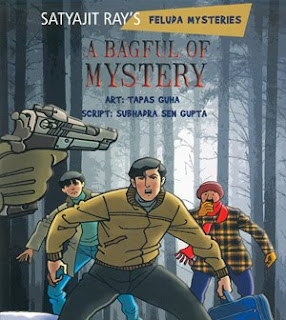
The first to fall victim was one of the most loved characters of the city- Prodosh C Mitter, aka Feluda and next came the comic book version of Shirshendu Mukhopadhyay’s Gosain Baganer Bhoot. But, most publishers are still to loosen up to the idea. As Sayan Mukherjee, a visualiser with Ogilvy, who is currently working on a graphic novel based on one of the cult classics of Bengali literature, says: “English graphic novels priced as high as Rs 800-1000 sell off the racks here but when it comes to a Bengali book, people are reluctant to shell out more than 200 bucks. Hence the publishers are ok till it is a 120-page comic book. But, when it comes to a full-length coloured graphic novel in Bengali, they shrug away. Even if they agree to publish there are constraints laid down on the use of space-every page has to be a busy page and that kills the very essence of a graphic novel.” But why venture into this market with a translated work? “If it is a well-known book, it creates the initial interest in people.”
So, while publishers like Ananda and Starmark work on their new projects, and literary giant fall prey to graphic novelists mushrooming on every nook and corner, it is yet to be seen how Tagore’s city reacts to a speech-bubbled Shesher Kobita!
Some of the most critically acclaimed works (in random order):

1. City of Glass by Paul Karasik and David Mazzucchelli (Spiegelman calls the graphic novel "a breakthrough work.")
2. Crime and Punishment by David Zane Mairowitz and Alain Korkos
3. Fahrenheit 451 by Tim Hamilton
4. Macbeth by John McDonald’s Artists Jon Howard, Gary Erskine, and Nigel Dobbyn
5. The Trial by Chantal Montellier
6. On The Origin Of Species by Michael Keller
7. The Jungle by Peter Kuper
8. The Stories Of Oscar Wilde by Antonella Caputo and Rich Rainey
9. The Divine Comedy by Seymour Chwast
10. Gravity's Rainbow by Zak Smith

The curious case of Indian superheroes


Disney’s recently released superhero Zokkomon has yielded a lukewarm response and Anurag Kashyap’s mega budget spectacle Doga (Based on Nagraj comics) and Vidhu Vinod Chopra’s Talisman (India’s answer to Lord of the Rings) have already been shelved. The 30-second- teaser of Shahrukh Khan’s most ambitious project Ra One leaves you in a state of déjà vu with its eerie resemblance to Endhiran (The Robot) ...and Krrish and Matrix. Yet it seems that Indian market is suddenly being invaded by a legion of superheroes and not all are spandex-clad B-grade versions of Superman. Even if Toonpur ka Superhero’s super powers did not work too well in Bollywood, spoofs of superheroes like the Tamil vegetarian cowboy Quick Gun Murugun won the audience’s heart with his over-the-top histrionics. Endhiran-The Robot wowed the audience with its superlative special effects and after its stupendous success, Rajnikanth has already started working on his next animated superhero avatar Rana. Saif Ali Khan is almost ready with his superhero venture-Agent Vinod. Salman Khan, a self-proclaimed non-believer in the genre, has also fallen prey to the latest craze and signed a superhero movie -and that too in 3D! Another movie to watch out for would be Prince Vaali-arguably the costliest film under production in the new superhero/sci-fi genre.
It is no denying the fact that Krrish (touted as the first Indian superhero movie) started the trend of mega budget superhero movies; but it is indeed Mr India that till date remains a cult favourite. Unlike RaOne, Mr India didn’t have the luxury to don a 1-crore suit; dressed in a simple jacket over a simple shirt and trouser, and a cricket hat, this common man became the most loved superhero of the country. Another unusual superhero duo is Satyajit Ray’s immortal characters (based on Upendra Kishore Roychowdhury’s book)-Goopi Gayen and Bagha Bayen.
However, as far as apna Bollywood is concerned it was the asli angry young man Amitabh Bachchan who had donned the cape and the spandex way back in the 80s when he subjected the audience to not one but three B-grade superhero movies-Ajooba, Toofan and Jaadugar (some might even prefer Drona over these...or maybe not!) along with a comic book avatar Supremo- a superman-like alter ego of Amitabh Bachchan clad in pink latex body suit and a lungi wrapped over it. This rather popular comic series had Gulzar as the script consultant! And Big B was not the only one to have a comic book superhero version! Sunil Gavaskar also battled cricketers from Bandookstan and England on the field and, between games, took on evil magicians in Sunny the Super sleuth.
Right from the half-forgotten to the super-hit Nagraj (each Nagraj comic used to print at least 3 lakh copies in the 90s) and Chacha Chudhary and his friend from Jupiter-Sabu, there was never a dearth of comic book superheroes. But, most of the comics were in Hindi and was hence not accessible to a large portion of Indian population. Even Doordarshan had its own superheroes in the form of the droolicious Captain Vyom and the ‘Indian Superman trained in Kundalini yoga’ Shaktiman (which apparently had children falling of buildings/ busses/ beds trying to imitate ‘the spin’). However, as India opened its windows to the virtual world, and terraces to dish antennas, most of these superheroes died a slow and painful death.
Meanwhile, in the West, superheroes inspired by Indian mythological characters or with an Indian ancestry began to crop up. However, most of these were no better than ‘American superheroes’ created in India barring the likes of Chandi Gupta, better known as "Maya,” of Justice League and Neal Shara aka Thunderbird in X-men.
In 2006 Virgin Group’s Sir Richard Branson, author Deepak Chopra, filmmaker Shekhar Kapur and Gotham Entertainment Group collaborated and formed Virgin Comics LLC(which became Liquid Comics in 2008) with the aim to create content based on Indian mythology and reach a global audience as well as start a creative renaissance in India. Virgin Comics gave the much needed push to revive Indian comic industry and came up with three superheroes: Devi, The Sadhu and Snake Woman.
With the comic industry getting a complete makeover, the superhero culture slowly started rising from its ashes in India. While old players like Raj comic tied up with Planet41 to deliver animated films starring Nagraj, Dhruv and Doga to 3G handsets and started contemporising the content(with Nagraj battling 26/11 terrorists), and new superheroes are also making their presence felt. And these new breed of superheroes are as different form each other as chalk and cheese. While Saurav Mohapatra’s Jimmy Zhinchak is “a spoof and homage to the Disco zeitgeist in 80's Bollywood (which made Mithun da + Bhappi Lahiri "world phemos" in India),” Rimi B Chatterjee’s (yet to be pulished) Kalpa: Shadowfalls has an unusual super hero who can inhabit the memory traces of the dead. But, Chatterjee is reluctant to call Kalpa a superhero: “I don't think Kalpa qualifies as a superhero. She doesn't have a costume or a secret identity”.
Level 10 comics’ Shaurya is a superhero story based on the Mumbai train blast. “Currently in its 7th issue, Shaurya is a team of five “gifted” teenagers from across India. We wanted to truly capture what it lifestyle of today’s college going crowd,” explains Suhas Sundar, the creative head of Level10comics. The publishing house is also working on San anti-hero title and their dark hero is set for an August re-debut.
The recent Comic Con India saw the launch of - Uud Bilaw Manus (Uud Bilaw Manus: Back with a Vengeance) aka UbiMa. The half-otter, half human superhero is the protector of the city of ‘Beehar’. With characters like Kitty, Kala Kutta, Bhade ke tattuu, Kung Fu Girgit , Kan Khajura and the language a hilarious mishmash of English, Hindi, Bhojpuri, UbiMa promises to take you on a laughter riot. According to Adhiraj Singh, the creator of the character, “This is a spoof on the superheroes and draws its inspiration from the quintessential action movies of the 80s.”
Jatin Varma, the director of Twenty Onwards Media, theUbiMa’s publisher has high expectations from the otterman: “I do see a long term investment in UbiMa, with more volumes of the comic series and maybe animated shorts in the future.”
However, he lives in no Utopian world and is quick to add: “Building a superhero character takes a very long time and huge investments. It is not something that can be done overnight with just a few volumes. The superheroes that are brand names have been around since our great-grandparents times.” Suhas points towards the lack of adaptations across different media and platforms as one of the main reasons behind the lack of a superhero brand in India. But, according to Mohapatra there is still a lack of original ideas. Not all have managed to come out of the western mould: “Frankly, you can't take Batman and make him wear a “mukut” and make him an "Indian" superhero.”
However, Shamik Dasgupta of Ramayana 3392 AD fame is optimistic: “The appeal of superheroes has been steadily growing from the last decade; all we need is a well done superhero befitting the modern youth of India.”
Though there is no doubt that the new breed of superhero breeders are increasingly concentrating on original content, a parallel trend of taking up characters and theme from Indian mythologies is also emerging. Adhiraj explains this phenomenon: “Indian mythology already has a rich bank of archetypes and themes to draw from. It takes less of a 'leap' from a reader (or a writer for that matter) for that story.” But, what is heartening to see is that the comics writers are becoming increasingly experimental with these age-old stories and giving them their own spin. Apart from the most common preys like Hanuman, Ganesh, Krishna, Raam, the superhero-hunters are looking out for unsuspecting victims in the half-yellow pages of Indian mythologies. Shamik’s Daksh- a story of a Gothic superhero inspired from the epic poem Meghadutam by Kalidasa. “I wanted Daksh to be dark and scary- a complete badass. He is the son of Yama and the gatekeeper of hell. Because of his negligence a hundred sinners escape from hell and as a punishment he is sent to earth to bring back all the escapees (and the hit-list includes the likes of General Hideki Tojo, Joseph Stalin, Adolph Hitler, Elizabeth Bathory, Idi Amin, Ghengis Khan, Caligula!),” explains Shamik.
Another interesting project in this genre is Vimanica comics’s The Sixth-Karan Vir (KV), the protagonist of the series is the reincarnation of Mahabharat’s Karna. He is a businessman who meets Ved Vyas, the author f the epic, and learns about the tumultuous life of the sixth son of Kunti. “As KV delves deep into the legend of Karna, he acquires certain super powers and as Ved Vyas finishes his narration, KV turns into a true superhero,” explains Karan Vir Arora, Ceo/founder, Vimanika comics. “Through this series we are not only telling a story of a superhero but also presenting an authentic, much-researched piece of history in a much entertaining way,” says Karan. The series also sees the first Sardar superhero Dev Daljit Singh who is KV’s side-kick.
Well, be it educative, gothic, serious, dark, funny- it seems this new generation of superheroes are finally breaking the shackles of the stereotypical underwear-on-leotard mould (and becoming hip if not anything else!). But, as the Indian superhero industry flexes its muscle to take on the likes of Superman, Batman and Sandman, let’s not forget that the baap of all super heroes is an unassuming Indian and he lives in no comic book but in Chennai, and Grady Hendrix of Slate magazine introduces him as: “A force of nature. If a tiger had sex with a tornado and then their tiger-nado baby got married to an earthquake, their offspring would be something like this.” Indeed he is talking about our very own Rajinikanth. He can kill the Spiderman with mere bug spray. Yanna rascal, Mind it!